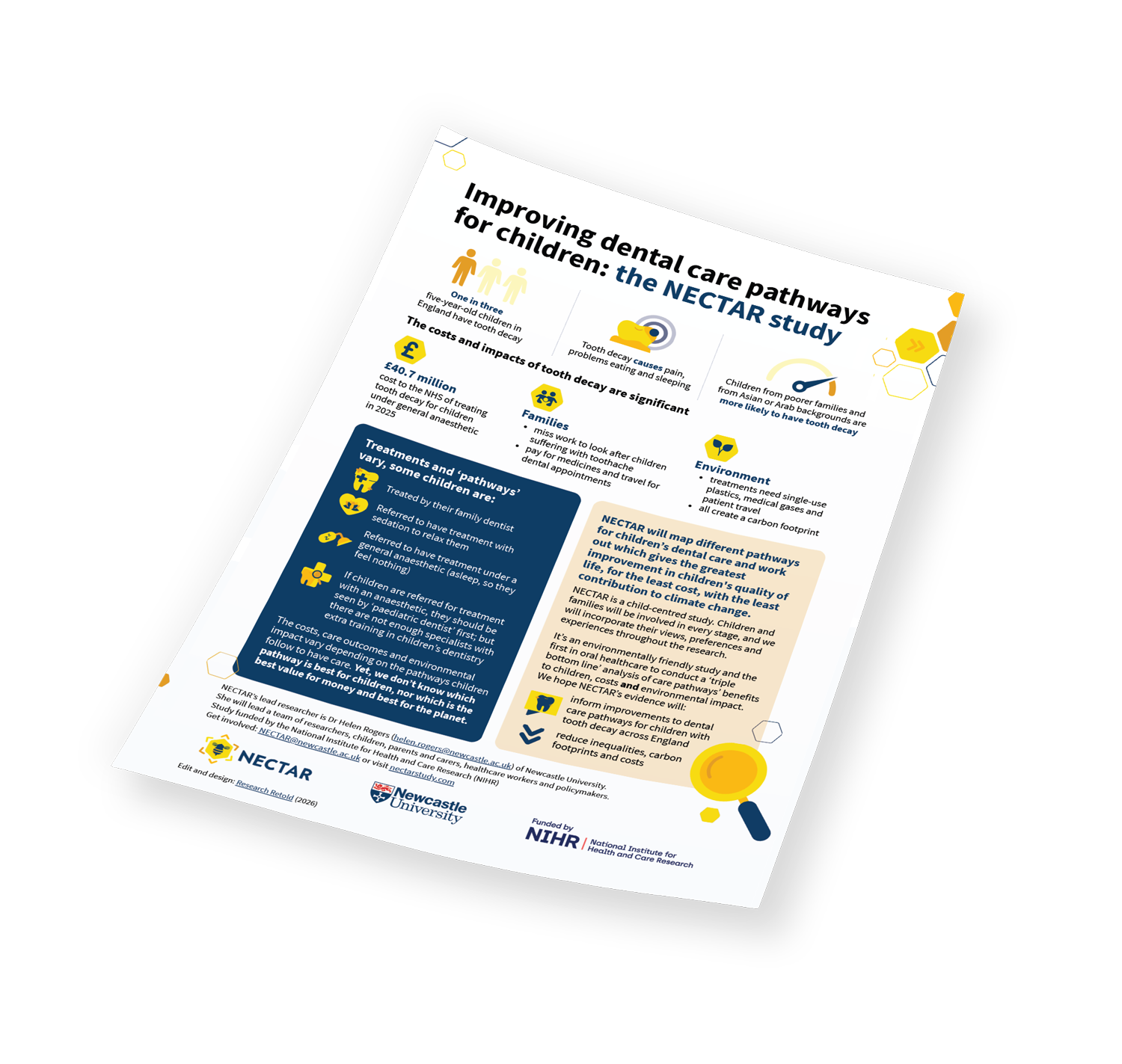
Improving dental care pathways for children: the NECTAR study

For many children in England, tooth decay means pain, lost sleep and missed school. It affects one in three five-year olds and is more common among children from poorer and some minority ethnic backgrounds. Access to the right care is uneven, and families often navigate complex pathways with varying levels of support. We’re working to understand how care can be improved, making it fairer, more effective and better for families and the NHS.

Children with tooth decay should ideally see a specialist dentist, who has extra training in caring for children’s teeth, before receiving sedation or general anaesthetic. However, due to limited availability, most children are treated by general dentists, which may not always meet their needs.

Treating tooth decay also has an environmental impact. Dentistry generates plastic waste, and travel as well as sedation and anaesthetic services contribute to carbon emissions.

When children need hospital-based treatment, the costs to the NHS can be significant, reaching £40.7 million in 2025 for general anaesthetic alone. Families may also face additional costs such as time off work, travel and medicines.

We aim to find out:
the best pathway to care for children with decay across England
if it makes a difference if children are seen by a specialist dentist
if it is better value for money for children with decay to be treated by their family dentist, or in a hospital or community setting
which route for treating tooth decay in children is best for the planet

This research is for:
Children who have experienced tooth decay and their parents
Members of the public who use NHS services, and who contribute to these services through their taxes
Teachers and others working in the primary school education sector, who see their pupils missing school due to tooth decay
Integrated Care Boards, particularly commissioners of dental services, and local authorities
Clinical teams who provide dental care for children with tooth decay
Anaesthetic teams, who provide general anaesthetics and sedation for children with tooth decay
Health economists and researchers focusing on dentistry and sustainability

What makes this project unique
The first study to look closely at the different journeys that children across England follow to access treatment for tooth decay
The first study to capture information on the cost of this care, both to the NHS and to families, and the impact that this care has on the environment
Children, parents and members of the public will be involved at every stage of this project; this helps us ensure our research is addressing key issues that matter most to them
Potential impact and change in the world
We hope that this work will produce evidence to guide fairer, more consistent, care for children with tooth decay across the country.
It will also demonstrate which care pathways for children with decay are most cost-effective for families and the NHS, and which approaches can help reduce the impact of care on our planet.
If our recommendations are introduced, it could also mean that the NHS has more funds available to invest in preventive care.
Download and share our one-page visual summary